
Published on: 2026-10-13
Dona Geagea started in October as an Advisor Environmental and Social Assessment at the NCEA. From a young age, she has been fascinated by the coexistence of different perspectives and how to bring them together. Read more about Dona and what drives her in her new job in this interview.
To start at the beginning: Where did you grow up. And how has it shaped the person you’ve become?
My story starts in Lebanon where I was born and raised at the tail end of the civil war in the late 80s. Growing up in a post-war society and seeing its impacts, I believe that really shaped who I am and how I see the world.
At age 14, my family migrated to Canada. Moving and transitioning out of Lebanon, adapting and adjusting, and spending over 20 years in Canada really allowed me to see the world through two lenses- what I call a hybrid lens. One is from the so-called “developing” context, a context I wasn’t aware of being labeled as such while I was in it. I never framed it that way. But in Canada I started to see how the context I grew up in was seen and perceived, how my new context was seeing me. To a certain degree I had to assimilate in a new culture, but not let go of my roots, my upbringing and the values that came with it. I think this is where my sensitivity around worldviews has originated. The plurality, respecting cultural diversity, respecting different ways and modes of operating, and recognising how different perceptions are being shaped for me are critical in any process of collaboration and stakeholder engagement.
“Recognising how different perceptions are being shaped for me are critical in any process of collaboration and stakeholder engagement.”
It sounds like a lifelong and deep personal journey. Did this also define your course in studies and career?
Indeed, working towards bridging different polarities became the purpose of my work and influenced my decision to study political science. Along the way, I realised that water was being framed as a critical issue for the future of our world (the next “world war”). As a topic that resonated with me personally, I wanted to challenge this perspective – water as a driver of conflict – and to explore how water can be a driver of cooperation. This led me to pursue a master’s degree in water governance, in Canada at McMaster University, with a joint graduate diploma in Water without Borders at the United Nations University – Institute for Water, Environment and Health.
“I wanted to challenge this perspective – water as a driver of conflict – and to explore how water can be a driver of cooperation.”
Through my thesis, I had the opportunity to conduct field research in Kisumu, Kenya. There, I critically explored how community-based water management functioned in practice and how international and national policies had a trickledown effect on governance at the local level.
After graduating, I began my career at the Canadian NGO Waterlution, an organisation dedicated to fostering dialogue around water. I focused on capacity building and training, particularly for early to mid-stage professionals navigating complex water issues. Later, I became Global Lead for the Water Innovation Labs, taking the organisation’s work from national focus to international partnerships. Through the social innovation labs approach we brought together groups of 50 to 100 participants in immersive learning journeys around the world. By engaging directly with local stakeholders and applying systemic thinking, we explored water challenges from different perspectives and developed more effective pathways for change. I was immersed in this work for 10 years.
Much earlier into my work with Waterlution, however, I came in contact with the Art of Hosting community as I was looking to find the right tools and methods to facilitate these water dialogues. These working methods provided such a great foundation for the rest of my world-work and career impacting the way I entered spaces and hosted collaborations and stakeholder engagement.
It sounds like a great opportunity. What are, so to say, the one or two basic principles that you took from all these years from the Art of Hosting?
The first one, is how to work with emergence- that being outcomes you cannot control such as when working in complex contexts where, you enter a dialogue, you enter a collaboration, you enter a room, but you don’t know what the outcome will be (this is working with emergence!). Here you need tools to help you navigate the space rather than going in “command and control” mode, which you know won’t work. How can you do it differently and enable collaboration over competition?
The other principle is about bringing the conversations to a deeper level of authenticity where people feel more comfortable to be themselves, not only show up in their roles. This is about enabling an environment of trust as the basis of any sustainable relationship and process of co-production. So, the art of hosting is an art for how to bring people together, host them through a process of working with both emergence and complexity and harness collective wisdom for taking informed wise action.
There is still so much for us to learn about this! What happened next in your career?
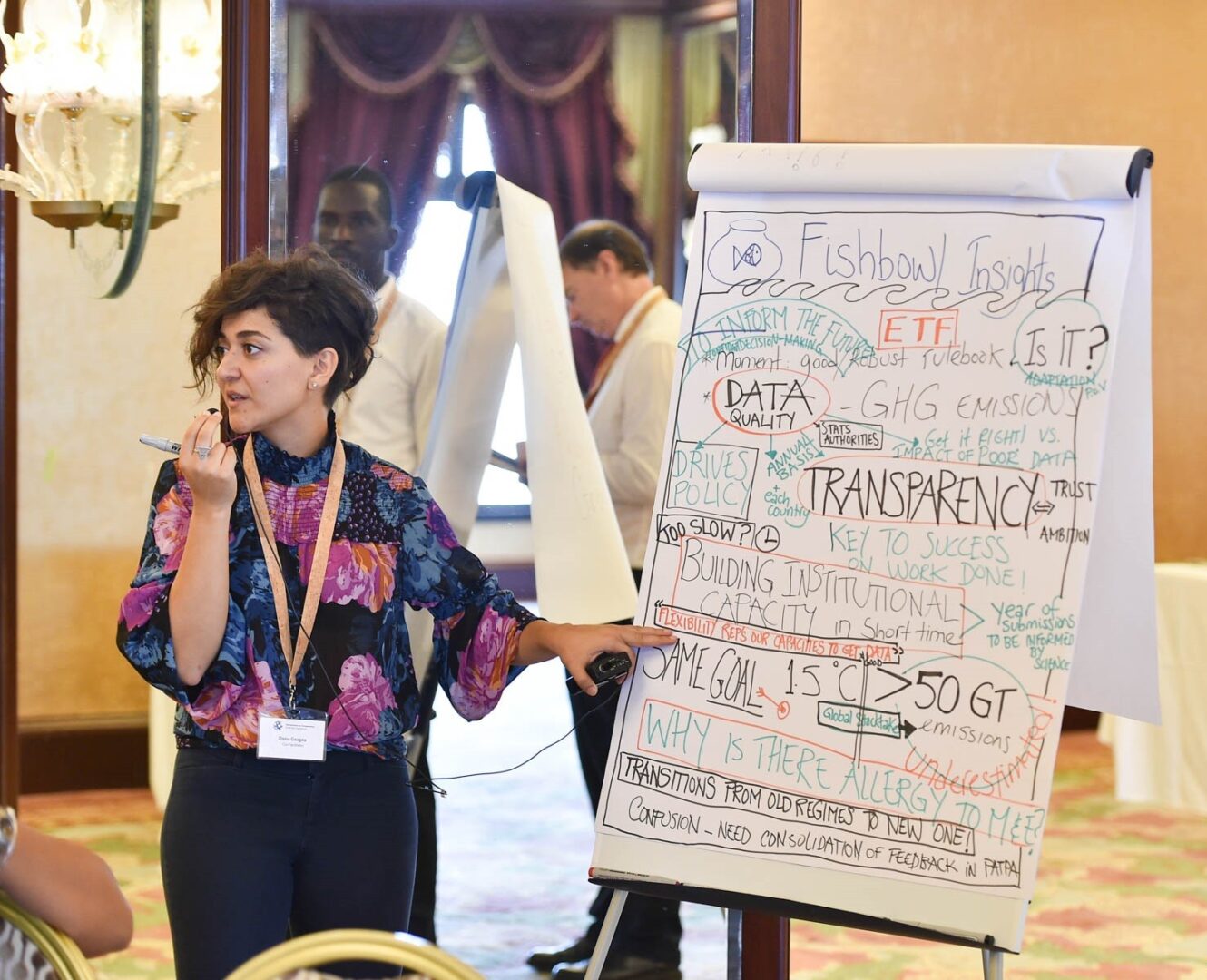
After a decade of working with the water innovation labs in several countries like Mexico, India, Lebanon, Australia, Portugal, Scotland, the Netherlands among others, and also through my own consulting work, I gained so much experience. For example, I worked with the Climate Transparency Group to the Paris Agreement as co-moderator of their annual pre-COP retreats. I then decided to pursue a PhD in water governance. This brought me to the Netherlands, where I had the chance to focus on how water decision-making can be influenced and co-designed bottom up through participatory governance and policy-making. After completing the PhD, I accepted a position as Postdoctoral Researcher in Water Risk Governance at the Public Administration and Policy Group at Wageningen University, co-leading research on mainly European countries that need to adapt to shifting paradigms from dealing with floods for centuries to now dealing with droughts under intensifying climate change conditions.
As I was exploring what my work in academia might look like, I felt a calling to return to being a practitioner, more on the policy level, while continuing to bridge knowledge and practices with academia. And then I came in contact with the NCEA. After 16 years of experience in the environmental governance field, with a particular specialisation in water, I am happy to join the NCEA and bring my experience to support countries in their decision-making processes on complex environmental and social dilemmas.
How do you perceive the work of the NCEA so far, and what are you looking forward to?
What has struck me from the beginning is the complexity behind requests that initially seem straightforward. As you dive deeper, you realise how many stakeholders, ministries and perspectives need to be involved, and how important it is to understand what is happening on the ground and to bridge perspectives throughout the process.
“What has struck me from the beginning is the complexity behind requests that initially seem straightforward.”
I think the role of the NCEA is to provide impartial advice, based on facts and on assessing how impact studies can be strengthened. At the same time, this allows us to bring different perspectives together and help decision-makers gain a clearer overview so they can make more informed choices.
In doing so, it is essential to recognise our positionality – we are a Dutch organisation working in diverse countries and contexts. That is why collaboration with partners must be a process of co-production. Rather than imposing a particular approach, we work together to understand what is needed and how we can best respond to the local context and needs.
In this first phase, I’m really looking forward to meet our partners, learn more about their challenges and ambitions, and see how what we can offer can align with their needs.